


A threat may begin with a short message, an angry phone call, or a phrase the sender thinks is only passing pressure. For the person affected, however, it may turn into genuine fear for personal safety, reputation, money, or family. For this reason, UAE law treats threats as conduct that may constitute a criminal offence when its legal elements and evidence are present, whether the threat is made verbally, in writing, through another person, or via social media and modern technologies.
In this guide, we explain the penalty for threats under UAE law, the legal elements of the offence, methods of proof, and the procedures for filing a threat report or complaint in Dubai, with a practical sample to help you organize the facts before presenting them to a specialized lawyer.
Have you been threatened in Dubai? Do not take a random step
Messages, calls, or online conversations may be important evidence, but the way they are presented to the competent authority can affect the strength of your position. The team at Advocator Dubai can help you review the incident and evidence, and identify the appropriate legal route with confidentiality and clarity.
Table Of Content
What is meant by the crime of threats under UAE law?
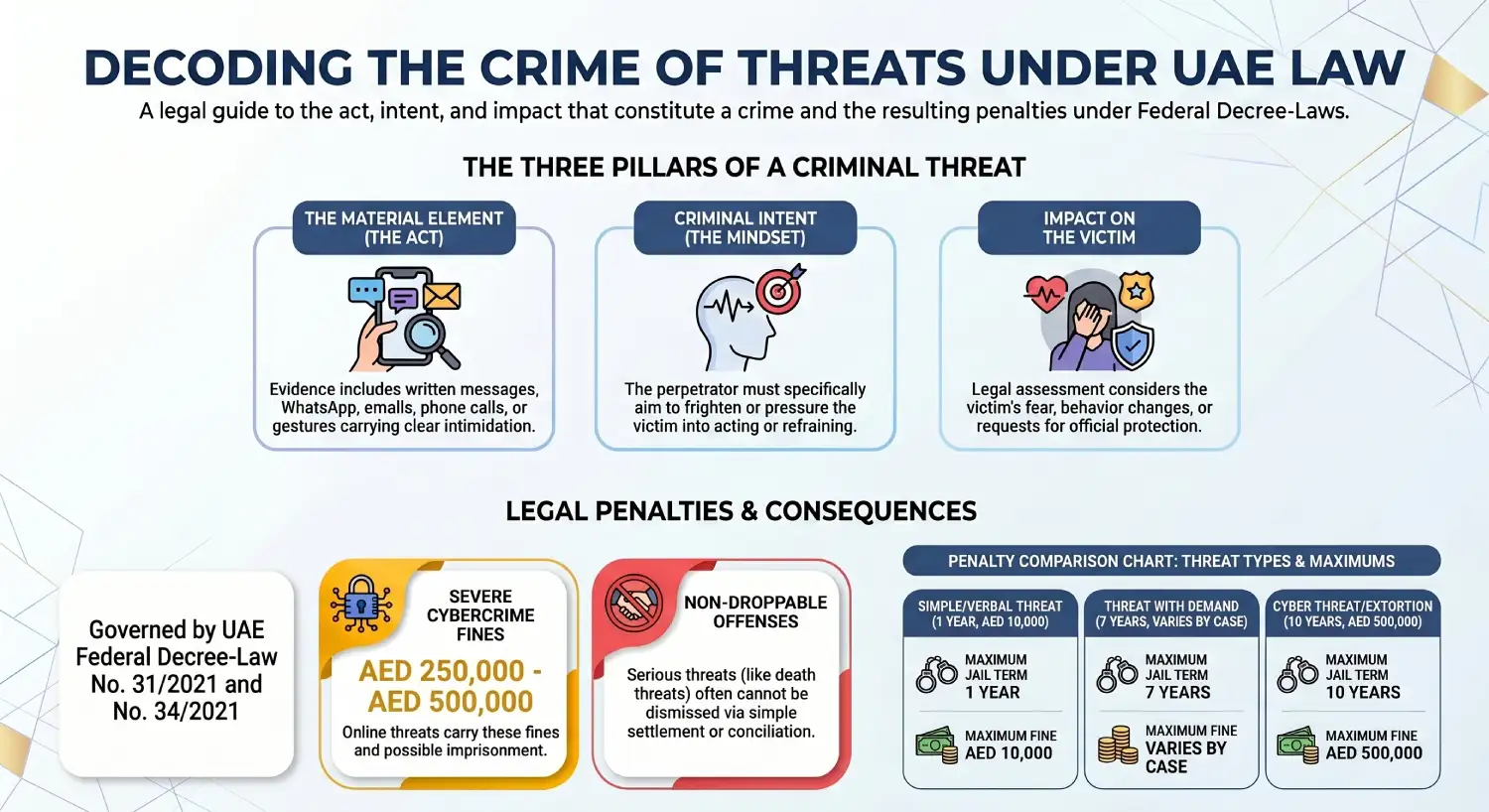
The crime of threats refers to using words, actions, writing, gestures, or a technological means to frighten or pressure another person, whether by threatening the person, their property, their reputation, or someone important to them. The threat may be direct, such as an explicit written warning, or indirect if it clearly implies harm or seeks to compel the victim to act or refrain from acting.
The perpetrator does not always have to carry out what they threatened to do. The offence may arise once the threat is made, provided the legal conditions are met and the threat can be proven. The legal classification and penalty differ depending on the method used, the nature of the threat, and whether it was accompanied by a demand, instruction, or blackmail.
Summary of the penalty for threats under UAE law
| Type of threat | Description | Potential penalty | Usually appropriate authority |
|---|---|---|---|
| Threat accompanied by a demand or instruction | Threatening to commit a felony or attribute matters affecting honor, while demanding an act or omission | Temporary imprisonment for a period not exceeding 7 years | Police, then Public Prosecution |
| Threat not accompanied by a demand | Threatening to commit a felony against a person or property, or to attribute matters affecting honor, without a demand | Imprisonment | Police or Prosecution, depending on the facts |
| Threat by words, actions, or gestures | A simple threat outside the more serious cases | Imprisonment for up to one year or a fine not exceeding AED 10,000 | Police |
| Electronic threat | Threat through WhatsApp, an online platform, or a technological means | Imprisonment and a fine; the penalty may reach temporary imprisonment in aggravated cases | eCrime or Dubai Police |
Penalty for threats accompanied by a demand or blackmail
The penalty becomes more serious when the threat is used to pressure the victim to do something or refrain from doing something. For example, a person may threaten another with harm, accuse them of something affecting their honor, or disclose private information unless they pay money, sign a document, or waive a right.
In this case, the law provides for temporary imprisonment for a period not exceeding seven years if the requirements of Article 402 of the UAE Crimes and Penalties Law are met.
Penalty for threats not accompanied by a demand
A threat may occur without the perpetrator asking the victim to perform a specific act. This includes threatening to commit a felony against the victim or their property, or to attribute matters affecting honor or reputation, without the threat being accompanied by a demand or instruction.
In this case, the penalty is imprisonment under Article 403 of the UAE Crimes and Penalties Law.
Penalty for a simple threat by words, actions, or gestures
If the threat is made by words, actions, gestures, in writing or verbally, or through another person, outside the more serious cases, the penalty may be imprisonment for up to one year or a fine not exceeding AED 10,000, in accordance with Article 404 of the UAE Crimes and Penalties Law.
Here, it is important to note that the legal classification of the incident does not depend on the wording alone. It also depends on the full context, the nature of the relationship between the parties, the method of threat, and the availability of evidence proving the incident.
Penalty for electronic threats in the UAE
If the threat occurs through WhatsApp, email, social media platforms, or any technological means, it may fall under electronic threat offences. The UAE Cybercrime Law penalizes anyone who blackmails or threatens another person to compel them to do or refrain from doing an act by using an information network or information technology means.
The penalty may be imprisonment for a period not exceeding two years and a fine of not less than AED 250,000 and not more than AED 500,000, or either of these two penalties. The penalty may become more severe in certain cases if the threat involves committing a crime or attributing matters affecting honor or reputation, and is accompanied by an explicit or implied demand.
Is a threat different from blackmail?
Yes. There may be overlap between them, but they are not always the same. A threat is a warning to cause harm or commit an act against a person, their property, or their reputation. Blackmail is usually linked to using that threat to force the person to pay money, do something, or refrain from doing something.
In cybercrime cases, threats and blackmail may combine when the perpetrator uses a technological means to pressure the victim, such as threatening to publish photos or conversations in exchange for money or a waiver.
When does a threat become a crime?
A threat becomes a crime when it includes a clear warning of harm to a person, property, or reputation, is directed at a specific person, and can be proven through messages, witnesses, recordings, or electronic evidence.
Not every angry statement automatically becomes a criminal threat. The matter is assessed by the investigating authority and the court based on the wording, context, conduct of the parties, and whether the threat is connected to a demand, pressure, or blackmail.
Elements of the crime of threats under UAE law
To understand the crime of threats accurately, it is necessary to look at its basic elements. The penalty is not determined merely by the existence of a dispute between the parties, but by whether the act of threat, intent, impact, and evidence are present.
The material element of the crime of threats
The material element is the act issued by the perpetrator that carries the meaning of a threat. This may include:
- A written message.
- A WhatsApp conversation.
- An email.
- A phone call.
- A verbal threat in front of witnesses.
- A gesture or action that carries the meaning of intimidation.
- A post or message on a social media platform.
The clearer, more specific, and more directly addressed the threat is to the affected person, the easier its legal assessment becomes.
Criminal intent in the crime of threats
A vague or passing phrase is not enough on its own. The intent of the perpetrator and the context of the incident must be examined. If the purpose of the statement is to frighten the victim, pressure them, or force them to act or refrain from acting, this may strengthen the criminal classification.
If the phrase does not carry a clear threatening meaning, or was said in a context that does not indicate intimidation or pressure, the legal assessment may differ depending on the details.
The effect of the threat on the victim
The psychological or practical effect of the threat is important in understanding the incident. The effect may appear through:
- The victim’s fear for themselves or their family.
- A change in the victim’s behavior because of the threat.
- A request for protection or the filing of a report.
- A medical or psychological report where appropriate.
- Clear pressure to pay money or waive a right.
How can you prove the crime of threats in Dubai?
Proving the crime of threats depends on the nature of the incident and how it occurred. If the threat was made in writing or electronically, messages, conversations, and account data are important forms of evidence. If the threat was verbal, witness testimony, circumstantial evidence, or available recordings may be relevant, subject to legal controls.
The most important means of proof include:
- Screenshots of conversations while keeping the original inside the application.
- Phone numbers or accounts used in the threat.
- Email or text messages.
- Links to accounts or posts.
- Voice or video messages.
- Testimony from those who attended the incident or heard the threat.
- A medical or psychological report if there is clear harm.
- Any previous report or document related to the dispute.
Evidence must be collected carefully, especially in matters involving privacy, recording, or publishing conversations. Trying to prove an offence in the wrong way may create a separate legal dispute.
Procedures for filing a threat report in Dubai
Procedurally, the more accurate starting point is usually for the affected person to file a criminal report or complaint, not a direct civil claim. The police receive the report and gather information and evidence, then the file may be referred to the Public Prosecution when appropriate for the necessary action.
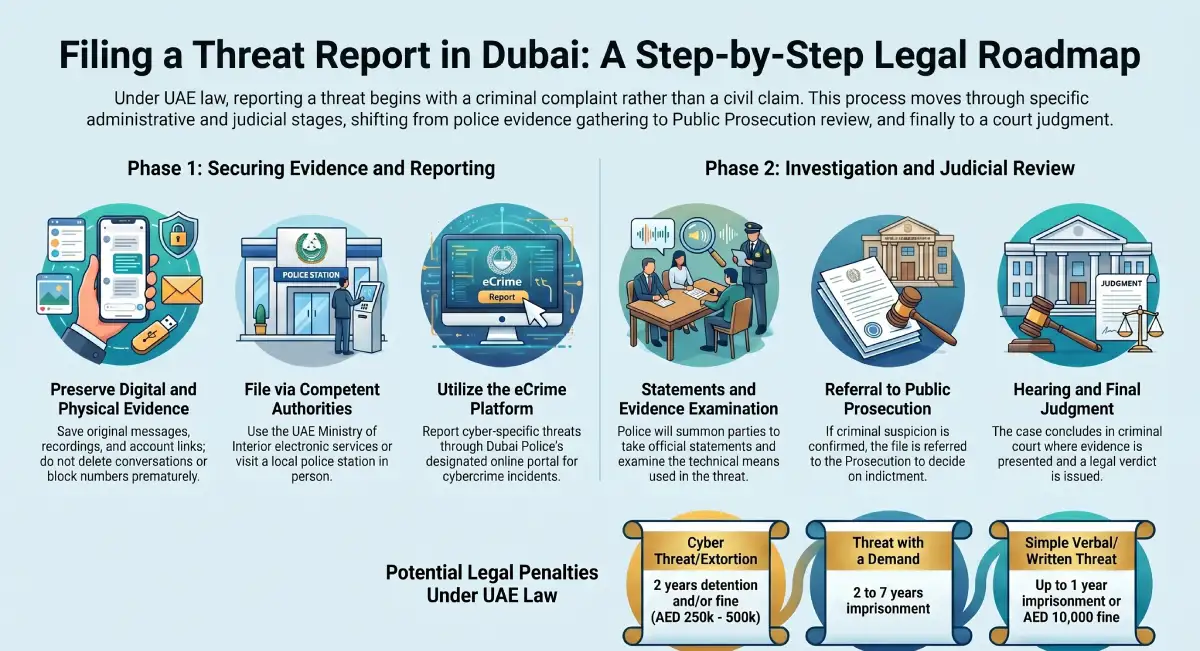
1. Preserve the evidence before filing the report
Keep the messages, images, recordings, or account links, and do not delete the original conversation. If the threat was made through WhatsApp or a social media platform, try to document the phone number or account name, as well as the time and date of the message.
2. File a report with the police
You may approach the competent police authority or use the available electronic channels to file the report, explaining the details of the incident and attaching the evidence. The UAE Ministry of Interior provides an electronic service for filing criminal reports with the ability to attach evidence and documents.
3. Use eCrime if the threat is electronic
If the threat occurred online or through information technology means and falls within Dubai’s geographical scope, the report may be filed through the Dubai Police eCrime platform. Official authorities state that this service is designated for registering cybercrime complaints within Dubai, with the need to provide as much information as possible about the incident.
4. Investigation and statements
After the report is filed, the complainant’s statement may be taken, the other party may be summoned, and evidence or reports may be requested. The conversations and the means used in the threat may also be examined.
5. Referral of the file to the Public Prosecution
If a criminal suspicion appears, the file is referred to the Public Prosecution to conduct the investigation and take the appropriate decision, whether by dismissing the matter, referring it, or taking other legal measures.
6. Hearing the case before the competent court
If the Public Prosecution considers the evidence sufficient, the case may be referred to the criminal court, where the evidence is presented, the defence is heard, and the court issues its judgment based on the facts and the applicable legal provisions.
Sample threat complaint in Dubai
This sample is for guidance only and should not be used as-is in every case. The wording of a complaint differs depending on the type of threat, the evidence, the competent authority, and whether the incident is electronic or direct.
To the respected competent authority in the Emirate of Dubai
Subject: Threat Complaint
I, [Complainant’s Name], holder of ID No. [ID Number], residing at [Address], contact number [Phone Number], submit this complaint against [Name of the person complained against, phone number, or account if the name is unknown], regarding a threat I was subjected to on [Date] through [Call – Message – WhatsApp – Email – Direct confrontation – Social media platform].
The person complained against threatened me with [state the content of the threat accurately without exaggeration]. This occurred due to [the dispute or reason, if any]. As a result, I felt fear and anxiety concerning [myself – my family – my property – my reputation – my work], especially as the threat included [a specific demand – blackmail – a threat to publish information – a threat of harm].
I attach the following documents for your review:
- A copy of my ID.
- Screenshots of the conversations or messages.
- The phone number or account used in the threat.
- Names of witnesses, if any.
- Any medical or psychological report, if available.
- Any other documents supporting the complaint.
Therefore, I respectfully request that you take the necessary legal measures, hear my statement, examine the attached evidence, and refer the complaint to the competent authority when appropriate.
Please accept my highest respect.
Name: [Complainant’s Name]
Signature: [Signature]
Date: [Date]
Contact Number: [Phone Number]
Need a legally drafted threat complaint?
The sample complaint does not suit every case. The complaint should clearly connect the facts, type of threat, evidence, and legal requests. The team at Advocator Dubai can review your documents before the report is filed.
Why do you need legal review in threat cases in Dubai?
In threat cases, the existence of a message or a dispute between two parties is not enough to reach a final legal assessment. The assessment depends on the wording, context, method of communication, whether the threat was accompanied by a demand or blackmail, and the validity of the submitted evidence.
Advocator Dubai can help you review the facts and evidence and determine the most suitable route, whether you are affected by a threat or facing an accusation related to one. The firm handles such matters with confidentiality, document review, and a clear explanation of the legal options without promises or exaggeration, in line with the sensitive nature of criminal cases in Dubai.
When do you need a criminal lawyer in Dubai for threat cases?
Some threat incidents may seem simple at first, but they can develop into a criminal case, cybercrime case, blackmail issue, or reputation-related dispute. For this reason, legal advice from a threat lawyer in Dubai is important in situations such as:
- If the threat is accompanied by a demand for money, a waiver, or a signature.
- If the threat relates to publishing photos, conversations, or private information.
- If the threat is made through social media or an unknown account.
- If you are accused of committing the crime of threats.
- If the evidence is not organized or you fear submitting it incorrectly.
- If the dispute is connected to work, a partnership, a family relationship, or professional reputation.
A criminal lawyer in Dubai can help study the facts, sort the evidence, identify the closest legal classification, and explain the available options before filing the report, during the investigation, or before the court.
What should you do if you are accused of making threats in Dubai?
If you receive a summons or learn that a threat report has been filed against you, it is important not to react emotionally. Do not delete conversations, do not send new replies that may be interpreted against you, and do not give an unprepared statement before understanding the content of the report and the evidence attributed to you.
In this situation, the full context of the messages or incident should be reviewed to determine whether the wording constitutes a legal threat or was said in a dispute that does not rise to the level of a crime. It is also necessary to check whether the report alleges a direct threat, an electronic threat, a threat accompanied by a demand, or blackmail.
Mistakes to avoid when you are threatened
If you are threatened in Dubai, avoid the following:
- Responding with a counter-threat, insult, or defamation.
- Publishing conversations publicly on social media.
- Deleting the original messages and relying only on screenshots.
- Paying money without legal assessment.
- Filing a general report without organizing the facts and evidence.
- Recording or publishing material that may affect another person’s privacy without legal review.
- Ignoring the threat if it is accompanied by blackmail, a demand, or a clear risk.
A calm and well-considered response may protect your legal position, whether you are affected by the threat or accused of making it.
Frequently asked questions about the penalty for threats under UAE law
What is the penalty for threats under UAE law?
The penalty for threats under UAE law varies depending on the nature of the threat. If the threat involves committing a felony or attributing dishonorable matters to another person, and is accompanied by a demand or instruction, the penalty may reach temporary imprisonment for a period not exceeding seven years. As for threats not accompanied by a demand, or simple threats, the penalty varies depending on the applicable legal provision and the circumstances of the incident.
What is the penalty for making threats via WhatsApp in the UAE?
If the threat is made through WhatsApp or any information technology means, it may fall under electronic threats. In such cases, the provisions of the UAE Cybercrime Law may apply, provided that the elements of the crime and the necessary evidence are established.
Are WhatsApp messages sufficient to prove the crime of threat?
WhatsApp messages may serve as important evidence, especially if they are clear and contain a direct threat or a threat accompanied by a demand. However, the strength of the evidence depends on the integrity of the conversation, the connection between the number or account and the person involved, the context of the incident, and any supporting evidence.
How can I file a threat complaint in Dubai?
A threat complaint in Dubai can be filed through the police or the relevant official channels. If the threat is electronic, the eCrime platform of Dubai Police may be used for cybercrime complaints that fall within the jurisdiction of the Emirate of Dubai.
When does a threat turn into extortion?
A threat often turns into extortion when the offender uses the threat to force the victim to pay money, perform an act, or refrain from doing something. An example would be threatening to publish private photos or information in exchange for money or a waiver.
Is verbal threat punishable under UAE law?
Yes, verbal threats may be punishable under UAE law if they can be proven and the elements of the crime are established. This may include witness testimony, legally obtained recordings, or other supporting evidence that confirms the threat occurred.
What is the difference between a simple threat and a threat accompanied by a demand?
A simple threat usually involves a warning or intimidation without being linked to a specific demand. A threat accompanied by a demand, however, involves pressuring the victim to perform an act or refrain from doing something, which is considered more serious in legal assessment.
Can a threat complaint be filed against an anonymous account?
Yes, a complaint may be filed against an anonymous account if there is evidence such as the account link, screenshots of the messages, the time of the incident, the platform name, and any information that may help the competent authorities trace the source of the threat.
The penalty for threats under UAE law shows that the legislator treats acts affecting a person’s safety, reputation, or property seriously, whether they occur verbally, in writing, or through electronic means. However, the strength of a legal position does not depend on fear alone. It depends on the clarity of the threat, its context, the evidence proving it, and the correct way of filing the report.
If you have been threatened in Dubai, or if you are facing an accusation related to a threat offence, early review of the facts may help you understand your legal position and avoid procedural mistakes.
Start with a clear legal consultation before escalation
Whether you are affected by a threat or accused of making one, understanding your legal position early can help you avoid mistakes and protect your rights. Contact Advocator Dubai to review the incident and evidence confidentially and professionally.
Sources
- UAE Legislation Platform: Federal Decree-Law No. 31 of 2021 Promulgating the Crimes and Penalties Law, Articles 402, 403, and 404 on threats.
- UAE Legislation Platform: Federal Decree-Law No. 34 of 2021 on Combating Rumors and Cybercrimes, Article 42 on electronic blackmail and threats.
- eCrime platform / Dubai Police and Dubai Electronic Security Center regarding reporting cybercrimes within Dubai.