



Understanding wife’s rights after divorce in Dubai is one of the most important legal matters before taking any legal action. Divorce is not only the end of a marital relationship, but it may also involve significant financial and family rights such as alimony, housing, child custody, child support, deferred dowry, and inheritance rights in certain cases.
These rights may vary depending on the type of divorce, whether children are involved, the religion and nationality of the spouses, the available documents, and the applicable law governing the dispute. Therefore, understanding the core legal rights before signing any settlement or filing a case can help protect the wife’s legal position and avoid waiving important rights that may affect her future and the future of her children.
Legal Consultation Before Taking Any Step
If you are facing a dispute regarding alimony, child custody, housing, or inheritance after divorce in Dubai, reviewing your documents before taking legal action can help you clearly and confidentially understand your legal options.
Table Of Content
Quick Answer: What Are a Wife’s Rights After Divorce in Dubai?
Wife’s rights after divorce in Dubai may include several legal entitlements depending on the circumstances of each case. A wife may be entitled to post-divorce maintenance during the waiting period (Iddah), suitable housing depending on the circumstances, and financial rights such as the deferred dowry stated in the marriage contract.
If children are involved, additional issues arise such as child custody after divorce in Dubai, child support, education expenses, medical costs, and housing expenses. As for inheritance after divorce in Dubai, inheritance rights do not apply in every situation. They may depend on the type of divorce and the timing of death, such as revocable divorce during the waiting period or certain cases of deathbed divorce.
Wife’s rights after divorce cannot be limited to one single claim, as each divorce case may involve multiple legal demands. A wife may need to claim alimony, seek custody, organize visitation rights, request housing support, or pursue deferred dowry and compensation claims.
The most common wife’s rights after divorce in Dubai include:
- Maintenance during the waiting period in legally applicable cases.
- Housing during the waiting period or suitable accommodation depending on the circumstances.
- Child support and essential child-related expenses.
- Custody rights if the legal conditions are met and custody serves the child’s best interests.
- Deferred dowry or financial rights established in the marriage contract.
- Compensation in some divorce cases initiated solely by the husband without fault on the wife’s part.
- Protection of the wife’s rights in jointly contributed assets or properties.
- Reviewing inheritance rights if death occurs during the waiting period of a revocable divorce or in deathbed divorce cases.
It is also important to understand that each spouse has an independent financial estate. Marriage or divorce does not automatically eliminate financial contributions or legally established rights, but such rights usually require supporting evidence and documentation.
Alimony for the Wife After Divorce in Dubai
Alimony for the wife after divorce in Dubai is one of the most common claims in family law cases. However, entitlement may differ depending on the type of divorce and the wife’s circumstances. Not every divorced wife is entitled to alimony in the same way, and wife’s alimony differs from child support.
When Is a Wife Entitled to Alimony After Divorce?
A wife may be entitled to alimony after divorce in certain situations under the UAE Federal Personal Status Law No. 41 of 2024, including:
- If she is in the waiting period following a revocable divorce.
- If she is pregnant during an irrevocable divorce waiting period, where maintenance is linked to the pregnancy until childbirth.
- If the court grants temporary maintenance while the case is ongoing.
- If there are children, where the court separately reviews child support obligations.
In revocable divorce cases, some marital effects remain during the waiting period, which may justify maintenance entitlement. In irrevocable divorce cases, entitlement depends on factors such as pregnancy status.
How Does the Court Determine Alimony?
When reviewing maintenance after divorce proceedings in Dubai, courts typically consider several factors, including:
- The husband’s income and financial ability.
- The needs of the wife or children.
- The standard of living before divorce.
- The number and ages of the children.
- Housing, education, and medical expenses.
- Financial documents submitted by both parties.
For this reason, consulting a Dubai alimony lawyer and preparing supporting financial documents such as salary certificates, bank statements, tenancy contracts, school fees, and medical bills can significantly assist in evaluating maintenance claims.
Housing Rights After Divorce in Dubai
Housing is one of the key issues after divorce, especially if the wife is still within the waiting period or has custody of children. Disputes may arise regarding staying in the marital home, obtaining alternative housing, or receiving a housing allowance.
Housing rights may depend on:
- The type of divorce.
- Whether children are involved.
- The wife’s status during the waiting period.
- The husband’s financial capability.
- The suitability of the marital home.
- The best interests of the child if the wife has custody.
In custody cases, courts consider housing not only as a financial issue but also in terms of the child’s stability, school proximity, and suitability of the living environment.
Can the Wife Receive Compensation After Divorce?
A wife may be entitled to compensation in certain divorce cases, particularly where the divorce was initiated solely by the husband without request or fault from the wife, or where the divorce or annulment resulted from the husband’s actions.
Compensation differs from maintenance and child support, so it is important not to confuse these separate financial rights. Rights that may be reviewed after divorce include:
- Maintenance during the waiting period.
- Housing support.
- Child support.
- Deferred dowry.
- Compensation.
- Financial rights established in the marriage contract.
- Joint financial contributions proven through documents.
Child Custody After Divorce in Dubai
Child custody after divorce in Dubai is one of the most sensitive family law matters because it concerns the child’s best interests above all else. Custody refers to caring for, raising, and protecting the child while managing their daily needs.
Generally, the mother is given priority in custody if she meets the legal conditions and custody serves the child’s welfare. However, courts evaluate each case individually and do not rely solely on general assumptions.
Factors Considered in Custody Cases
When reviewing custody cases, courts may consider:
- The children’s ages.
- The parents’ ability to provide care.
- The child’s educational and health stability.
- The child’s living environment.
- Any circumstances affecting the child’s welfare.
- The custodian’s availability and ability to care for the child.
- The child’s relationship with each parent.
If the wife is seeking custody, it is important to provide evidence demonstrating her ability to create a stable and safe environment for the child, such as housing, school, and healthcare documents.
Conditions for Custody in Dubai
Custody is not granted solely based on family relation. Courts usually evaluate several conditions related to the custodian’s suitability, including:
- Mental competence and adulthood.
- Trustworthiness.
- Ability to care for and raise the child.
- Freedom from dangerous or contagious diseases.
- Absence of circumstances harming the child’s interests.
- No addiction to drugs, alcohol, or intoxicating substances.
- Providing a suitable environment for the child.
This is where a Dubai child custody lawyer can assist in organizing the custody file, identifying necessary documents, and presenting the child’s best interests clearly before the court.
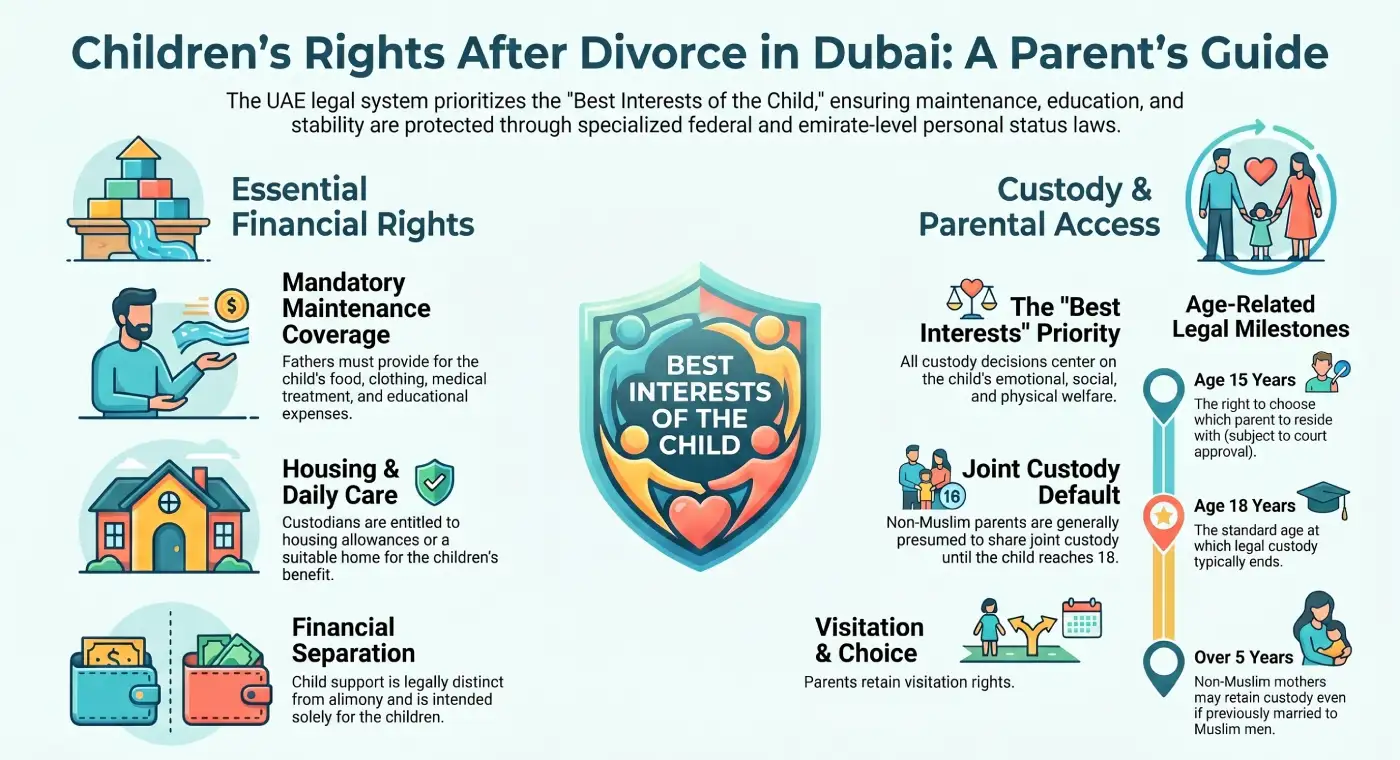
Children’s Rights After Divorce in Dubai
Divorce does not affect children’s rights. Their rights to maintenance, education, healthcare, and care remain protected regardless of whether custody is granted to the mother or father.
Children’s rights after divorce in Dubai generally include:
- Food and clothing expenses.
- Housing expenses.
- Education.
- Medical treatment.
- Daily care.
- Visitation and contact rights.
- Inheritance rights from both parents if inheritance conditions are met.
It is important to distinguish between the mother’s custody rights and the children’s financial rights. Even if the mother has custody, child support is intended for the children’s benefit rather than the wife personally.
Inheritance After Divorce in Dubai: Can a Divorced Wife Inherit?
Inheritance after divorce in Dubai is often misunderstood. Some believe divorce always prevents inheritance, while others think a divorced wife always inherits. In reality, the answer depends on the type of divorce and the timing of death.
When Can a Divorced Wife Inherit?
A divorced wife may inherit in two primary situations:
- Revocable Divorce During the Waiting Period
If the husband dies during the waiting period following a revocable divorce, the wife may still inherit because some marital effects continue during this period. - Deathbed Divorce
If the husband divorces his wife during a terminal illness without her request, she may retain inheritance rights under certain legal conditions unless she remarries before his death.
Therefore, the question “Can a divorced wife inherit in Dubai?” does not have one universal answer. The type of divorce, date of death, waiting period status, and reason for divorce must all be examined carefully.
When Does a Divorced Wife Lose Inheritance Rights?
Generally, a wife does not inherit if the divorce was irrevocable and the marital relationship fully ended before the husband’s death, unless an exceptional situation such as deathbed divorce applies.
Several questions must be examined, including:
- Was the divorce revocable or irrevocable?
- Did the death occur during the waiting period?
- Did the divorce occur during a terminal illness?
- Was the divorce requested by the wife or initiated solely by the husband?
- Did the wife remarry before the husband’s death?
- Are there documents proving the dates of divorce and death?
These details can significantly affect the legal outcome, which is why inheritance disputes after divorce require careful legal analysis.
What Share Does the Wife Receive If Inheritance Applies?
If inheritance rights apply, the wife’s share is determined according to applicable legal and Sharia rules. Generally, the wife may inherit one-quarter if the husband leaves no children, or one-eighth if he has children. If there are multiple wives, they share the prescribed portion collectively.
However, determining the final inheritance share requires identifying all heirs, reviewing debts and wills, and completing the legal estate distribution process.
Does Divorce Affect Children’s Inheritance Rights?
No. Divorce between parents does not affect the children’s inheritance rights from either parent. Children remain entitled to inheritance whenever legal inheritance conditions are met.
The estate is distributed according to the applicable legal shares regardless of whether the parents remained married or divorced.
Can Inheritance Be Agreed Upon Before or After Divorce?
This issue must be approached carefully. Ordinary agreements between spouses cannot override inheritance laws or deprive legal heirs of their rights. However, certain financial arrangements may still be legally organized, such as:
- Settling financial rights during divorce.
- Documenting agreements regarding maintenance, housing, or deferred dowry.
- Preparing a will within legal limits.
- Organizing financial arrangements for non-Muslim spouses under the applicable law.
- Agreements among heirs after death if valid and consensual.
For this reason, no inheritance-related agreement or financial waiver should be signed without proper legal review.
When Does a Wife Need a Divorce Lawyer in Dubai?
A wife may need a divorce lawyer in Dubai if there is a dispute involving maintenance, custody, housing, deferred dowry, or inheritance after divorce. Legal consultation is also important before signing settlements or waivers, especially when the applicable law is unclear.
The need for a specialized lawyer becomes even more important in situations such as:
- The husband refusing to pay maintenance.
- Custody disputes involving children.
- Jointly owned properties or financial assets.
- Disputes regarding deferred dowry or financial rights.
- The husband’s death after divorce and resulting inheritance disputes.
- The wife being a foreign national or non-Muslim.
- Existing court proceedings.
How Can Advocator Dubai Assist in Divorce-Related Rights Cases?
Advocator Dubai provides legal support in family law and divorce-related matters through careful document review, legal assessment, and strategic guidance tailored to each case while maintaining confidentiality and professionalism.
The firm’s services in these matters include:
- Legal consultations regarding wife’s rights after divorce in Dubai.
- Reviewing divorce agreements and settlements before signing.
- Claims involving maintenance, child support, and housing.
- Representation in custody, visitation, and family disputes.
- Reviewing inheritance cases after divorce, including revocable divorce and deathbed divorce.
- Preparing legal memoranda and handling court proceedings.
- Providing legal guidance for non-Muslim and foreign wives based on the applicable law.
Frequently Asked Questions About Wife’s Rights After Divorce in Dubai
What are the wife’s rights after divorce in Dubai?
A wife’s rights after divorce in Dubai may include maintenance in legally applicable cases, housing, deferred dowry or established financial rights, and child custody if the legal conditions are met and custody serves the child’s best interests. Her inheritance rights may also be reviewed in specific situations, such as revocable divorce during the waiting period or deathbed divorce cases.
Is the wife entitled to maintenance after divorce in Dubai?
A wife may be entitled to maintenance after divorce depending on the type of divorce and her circumstances. In revocable divorce cases, she may be entitled to maintenance during the waiting period. In irrevocable divorce cases, the matter may differ, while a pregnant wife may be entitled to maintenance in certain cases until childbirth. Child support remains a separate issue assessed according to the children’s needs and the father’s financial ability.
Does the wife have the right to housing after divorce in Dubai?
A wife may have the right to housing during the waiting period or when she has custody of children, depending on the circumstances of the case and the court’s decision. The matter is usually assessed based on the type of divorce, the presence of children, and the child’s best interests.
Can a wife inherit after divorce in Dubai?
A wife does not inherit after divorce in every case. She may inherit if the husband dies during the waiting period following a revocable divorce, and she may also inherit in certain deathbed divorce cases if the legal conditions are met. In irrevocable divorce cases, inheritance rights generally end unless an exceptional situation applies.
Does divorce affect the children’s inheritance rights?
No. Divorce between parents does not affect the children’s right to inherit from either parent. Children’s inheritance rights remain valid whenever the legal inheritance conditions are met and no legal barriers apply.
Who gets child custody after divorce in Dubai?
Generally, the mother has priority in child custody after divorce, but the court always considers the child’s best interests, the custodian’s qualifications, and the ability to provide proper care. Therefore, the outcome may vary depending on the details of each case.
What documents are required to claim the wife’s rights after divorce in Dubai?
Important documents may include the marriage contract, divorce certificate or proof of divorce, children’s birth certificates, income statements, tenancy contracts, education and medical expense invoices, and any documents proving expenses, financial rights, or joint contributions.
When does a wife need a divorce lawyer in Dubai?
A wife may need a divorce lawyer in Dubai when there is a dispute regarding maintenance, custody, housing, inheritance, deferred dowry, or when she is asked to sign a settlement before understanding its legal consequences. Reviewing documents before taking legal action can help protect her legal position.
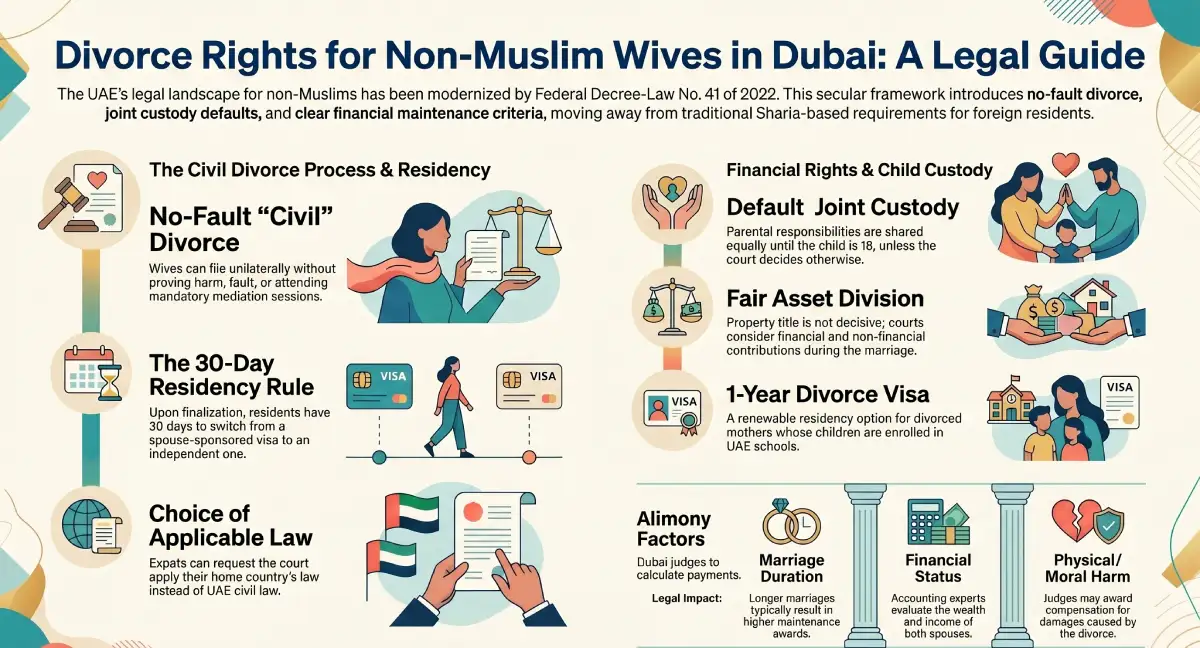
Do the rights of a non-Muslim wife differ after divorce in Dubai?
Yes. The rights of a non-Muslim or foreign wife may differ depending on the applicable law, the parties’ nationality, religion, and the nature of the marriage. Therefore, consulting a family lawyer in Dubai before filing a claim or signing a divorce agreement is highly recommended.
Can a wife claim the deferred dowry after divorce?
Yes. A wife may claim the deferred dowry if it is established in the marriage contract or supported by valid documents. Proving this right depends on the wording of the contract and the available evidence.
Do Not Take Legal Action Before Understanding Your Position
Whether your concern relates to maintenance, custody, housing, deferred dowry, or inheritance after divorce in Dubai, reviewing your situation legally can help you understand your available options before signing agreements or escalating the dispute.
Wife’s rights after divorce in Dubai extend beyond maintenance alone. They may include housing, custody, child support, deferred dowry, compensation in some cases, and even inheritance rights under specific legal conditions. Understanding the type of divorce, preparing documents, and clearly identifying legal claims are among the most important steps in protecting a wife’s legal position.
In cases involving children, shared assets, inheritance disputes, or spouses from different nationalities and religions, obtaining legal advice becomes even more important before signing any agreement or starting legal proceedings.